- The Value Mindset
- Posts
- Why You're Overpaying for Synthetic Oil Changes (And What Shops Don't Tell You)
Why You're Overpaying for Synthetic Oil Changes (And What Shops Don't Tell You)

Alex Kirkendall
February 21, 2025
Walk into any major auto service center, and you'll notice a significant price difference between conventional and synthetic oil changes. At the lowest cost oil change I could find in my area (without special pricing or coupons) a conventional oil change costs $24.88 while a synthetic oil changes runs you $54.88 at the same place. That's quite a gap with the synthetic variation more than double the price – but what if I told you this price difference isn't exactly what it seems?
Understanding the Basics: Synthetic vs. Conventional Oil
Before we dive into the pricing mystery, let's quickly cover the basics. There are (5) general categories defined by API 1509 Annex E [4] for base stocks. A “base stock” is the primary constituent of engine oil. These 5 base stock categories are defined based on their saturate content, sulfur content, and viscosity index as seen in the chart below:
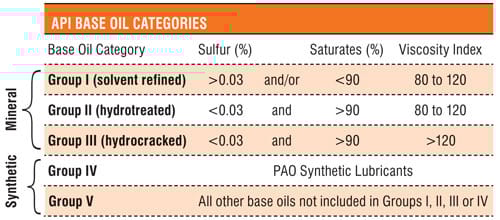
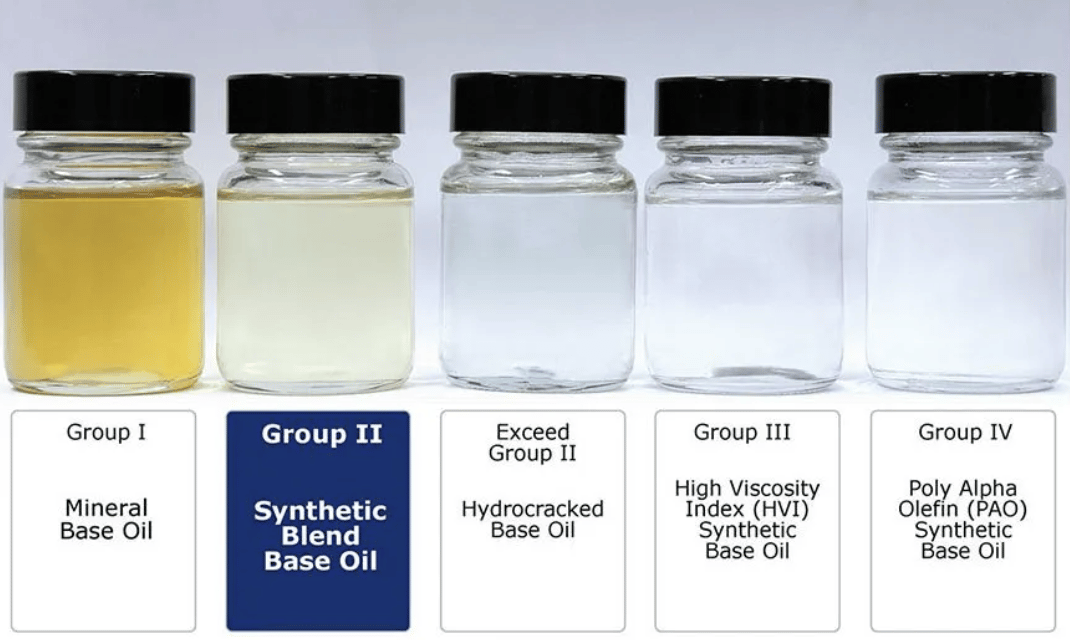
Quality conventional oils are typically made from Group II base stocks, whereas today’s synthetic oils are either Group III or Group IV. “Group IV base stocks are true “synthetic” base stocks in the technical sense of the word” but due to a ruling On March 1, 1999, by National Advertising Division (NAD) on case #3526 regarding engine oil, many synthetic oils found on the market today are actually just highly processed Group III crude oils. It’s important to note, as none of the major oil specifications (API, ACEA, ILSAC) explicitly require group III or IV base oil, all that matters is if they meet the minimum performance specifications.
When synthetic oil first hit the market, it genuinely was more expensive to produce, justifying its higher price tag. Although it’s hard to find specific data behind the cost of production of conventional vs. synthetic motor oil, it appears that (based on empirical consumer data) that manufacturing processes have evolved dramatically over the past decades, and the cost difference between producing synthetic oil and conventional oil has shrunk significantly.
The Real Cost Breakdown
Let's look at what you're actually paying for. If you were to do an oil change yourself, you'd find something surprising: a five-quart jug of quality synthetic oil at Wal-Mart costs only 9% more. The oil filter? Exactly the same price regardless of which oil you choose.
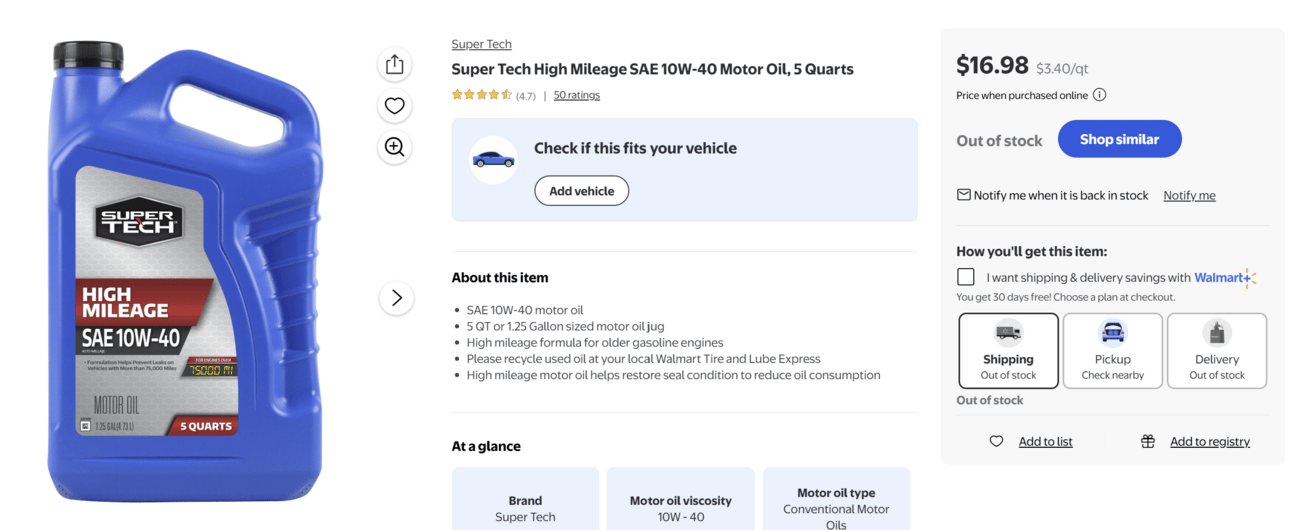 Super Tech Conventional Motor Oil $16.98 | 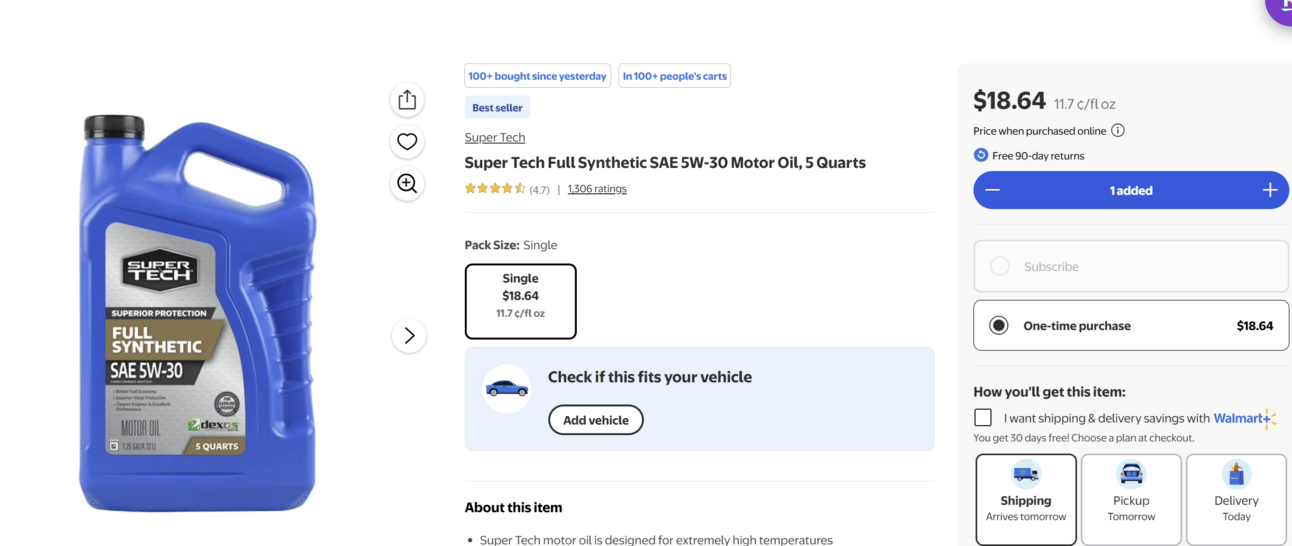 Super Tech Full Synthetic Motor Oil $18.64 |
So why are you paying $30-40 more for a synthetic oil change at the shop? It's not because of:
Additional labor (it's the same process)
Special equipment (it's the same tools)
Higher supply costs (as we've established)
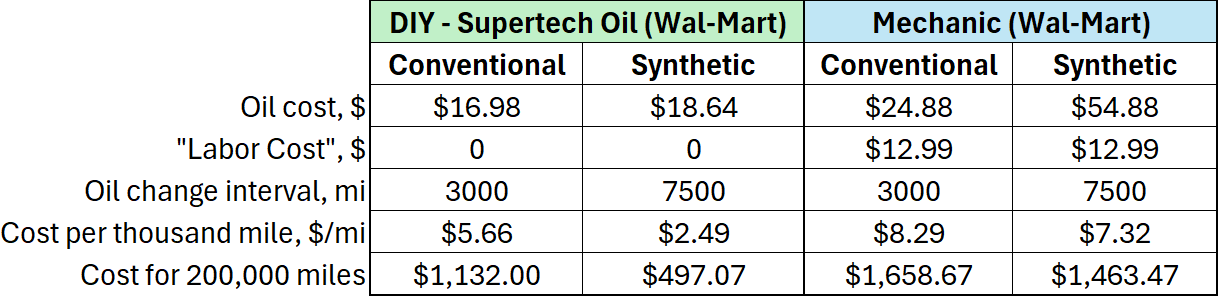
DIY vs. Mechanic Oil Change - Alex Kirkendall
The real reason? Consumer psychology and market positioning.
The Psychology Behind the Pricing
Auto service centers have masterfully positioned synthetic oil changes as a premium service, and we've all bought into it. They've leveraged our understanding that synthetic oil is "better" (which it is) to justify a larger price gap than what actually exists in their costs.
This isn't entirely manipulative – synthetic oil does offer superior protection and performance. But the price difference has become more about perception than reality. Shops know that consumers who choose synthetic oil are often:
More concerned about their vehicle's longevity
Generally willing to pay more for quality
More likely to have newer or higher-end vehicles
Can compute the cost/mile comparison relatively quickly seeing that the synthetic oil is still providing a lower cost/mile regardless of the higher cost
This creates a perfect storm for premium pricing, regardless of actual costs.
The True Value Proposition
Here's where things get interesting: synthetic oil is genuinely superior to conventional oil. It:
Lasts longer between changes
Provides better engine protection
Performs better in extreme temperatures
Can improve fuel efficiency
And, when you factor in that you can go longer between changes with synthetic oil (often 7,500-10,000 miles versus 3,000-5,000 for conventional), the cost-per-mile still often works out better with synthetic oil – even at current shop prices. However, depending on how you value your time, effort, safety, etc. you could save even more by recognizing the artificial markup at the shop and changing your own oil.
Making Smarter Decisions: Beyond the Presented Options
This isn't an article trying to convince you to change your own oil. Many people can easily justify professional oil changes when considering their time, convenience, safety, and risk factors – and that's perfectly reasonable.
The real insight here is about how options are presented to consumers. When you pull into a service center, you'll typically see something like:
Option A: Conventional Oil Change - $24.88
Option B: Synthetic Oil Change - $54.88
These options are carefully crafted to create a comparison point. The higher price of the synthetic oil change seems more palatable when presented alongside the conventional option. But what you don't see are Options C and D – alternatives that aren't displayed at the checkout counter.
Think of it like an ice cream shop. They'll show you prices for one, two, or three scoops, but they won't advertise that you could buy a whole quart of premium ice cream at the grocery store for the price of their two-scoop serving. The options presented are designed to frame your decision-making within a specific context that benefits the business.
The key takeaway isn't about whether you should or shouldn't pay for professional oil changes. It's about developing awareness of how options are presented and remembering to consider alternatives beyond the immediate choices in front of you. Smart consumers always ask: "What options am I not being shown?"
The Bottom Line
Synthetic oil is superior to conventional oil – that's not in question. What's worth questioning is the size of the premium you're being charged, especially now that you understand it's not driven by actual cost differences. The markup exists largely because shops know consumers will accept it when presented as one of two options.
The next time you're due for an oil change, remember: every purchase decision exists in a broader context than just the options presented to you. While the shop shows you a simple choice between conventional and synthetic, there's a whole spectrum of alternatives they don't display – from DIY options to competing shops to extended change intervals with premium oils.
Whether you ultimately choose the convenience of shop services or explore other options, being an informed consumer means looking beyond the menu of choices presented to you. The best value isn't always about paying less – it's about understanding the full range of options available and choosing the one that best fits your needs, even if it wasn't one of the choices initially presented to you.